 Parth Shah
on
Parth Shah
on
Introduction
A startup term sheet can look attractive until one line changes the ownership math. A ₹40 crore valuation, a ₹10 crore investment and a 10% ESOP pool can produce very different founder outcomes depending on whether the valuation is pre-money or post-money, what counts as fully diluted capital and when the option pool is created.
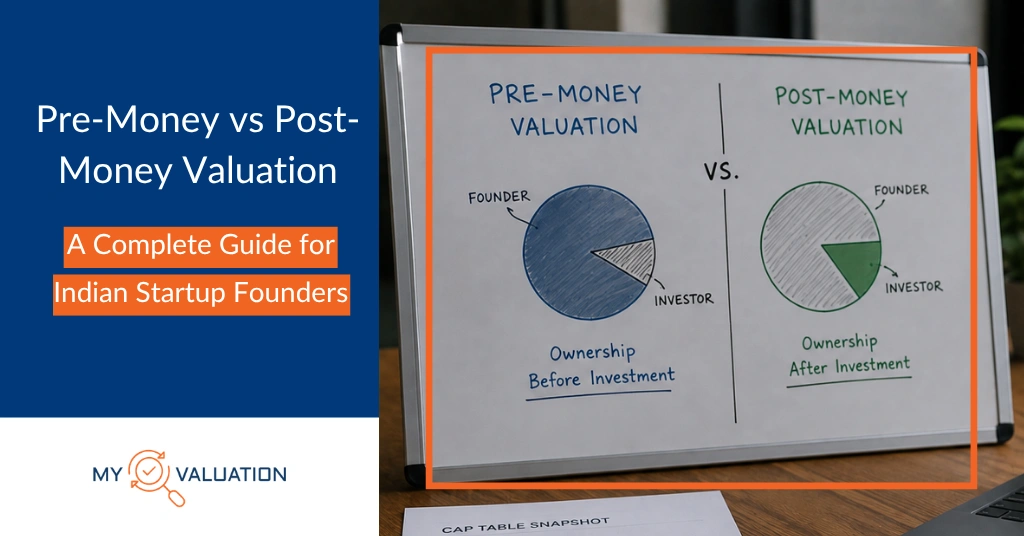
Pre-money valuation is the agreed value of the company immediately before the new equity investment. Post-money valuation is the value immediately after that investment. In a simple priced equity round, post-money valuation equals pre-money valuation plus the new primary investment. The investor’s ownership is then calculated against the post-money capitalization.
The formula is simple, but ESOPs, convertibles, secondary sales and India-specific pricing rules can change what the headline means economically. The underlying valuation also needs to be supported by assumptions that reflect the startup’s stage, financial performance, growth outlook and available market evidence. Founders preparing for a funding round can explore our startup valuation services for support with this valuation workstream.
This guide shows Indian startup founders how to calculate dilution, model the cap table and separate deal value from regulatory valuation so competing offers can be compared on ownership, not headline valuation alone.
Key Takeaways
- Pre-money comes first. Pre-money valuation is the company’s negotiated equity value before the new primary investment is added.
- Post-money includes new cash. In a clean priced round, post-money valuation equals pre-money valuation plus the new equity investment.
- Ownership uses post-money math. Investor ownership is generally the investment amount divided by the post-money valuation, subject to the agreed capitalization definition.
- The denominator matters. Price per share is usually calculated using an agreed pre-money fully diluted share count, not merely the shares currently issued.
- ESOP timing can move dilution. A pool created or topped up before closing can reduce founder ownership even when the headline pre-money valuation does not change.
- Convertibles need explicit treatment. iSAFE, convertible notes, CCPS and other instruments can change the share count and should be modeled under the actual term-sheet definitions.
- Commercial value is not regulatory FMV. A negotiated pre-money valuation does not automatically satisfy every Companies Act or FEMA pricing requirement that may apply to the issuance.
- Use current 2026 tax law. The old angel-tax clause stopped applying from April 1, 2025, and the Income Tax Act, 2025 replaced the 1961 Act from April 1, 2026, so legacy references should not be treated as current deal-pricing rules.
What Is Pre-Money Valuation?
Pre-money valuation is the agreed equity value of a startup immediately before the new financing enters the company. If an investor agrees to invest ₹10 crore at a ₹40 crore pre-money valuation, the existing shareholders are collectively treated as owning ₹40 crore of equity value before the investor’s cheque is added.
For founders, pre-money valuation is a negotiation anchor, not a guaranteed sale price. It can reflect stage, traction, growth, unit economics, market opportunity, team quality, forecasts, comparable transactions and negotiating leverage.
The key practical question is not only, ‘What is the pre-money valuation?’ It is also, ‘What securities and shares are included in the pre-money capitalization?’ That second question determines the actual price per share and the ownership each party receives.
What Is Post-Money Valuation?
Post-money valuation is the equity value immediately after the new primary investment is included. In the same example, ₹40 crore pre-money plus ₹10 crore of new equity investment gives a ₹50 crore post-money valuation. The incoming investor would own 20% before considering any additional complications because ₹10 crore divided by ₹50 crore equals 20%.
Post-money valuation turns the funding amount into an ownership percentage and provides a common denominator for the post-close cap table.
The addition formula works best for a clean primary equity round. With secondary sales, conversions or other instruments, the documents must define what is included in the quoted post-money figure.
Pre-Money vs Post-Money Valuation
| Decision Point | Pre-Money Valuation | Post-Money Valuation |
| Timing | Before the new primary investment | After the new primary investment |
| Basic formula | Post-money minus new primary investment | Pre-money plus new primary investment |
| Main negotiation use | Sets the value attributed to existing equity | Shows value after the round |
| Investor ownership | Derived through post-money math | Investment divided by post-money value |
| Share-price input | Pre-money value divided by agreed pre-money fully diluted shares | Not normally a separate share-price method |
| Key founder risk | Ignoring ESOPs, convertibles or fully diluted terms | Assuming the headline number alone shows founder ownership |
How Do You Calculate Investor Ownership and Founder Dilution?
For a straightforward priced round, start with three formulas. They answer most first-pass ownership questions before you move into the detailed cap table.
Post-money valuation = Pre-money valuation + New primary investment
Investor ownership % = New primary investment / Post-money valuation
Pre-money price per share = Pre-money valuation / Agreed pre-money fully diluted shares
Worked Example: ₹40 Crore Pre-Money + ₹10 Crore Investment
Assume a startup has a negotiated pre-money valuation of ₹40 crore and a new investor will invest ₹10 crore entirely as primary capital. Ignore ESOP top-ups and convertibles for the moment.
| Item | Result |
| Pre-money valuation | ₹40 crore |
| New primary investment | ₹10 crore |
| Post-money valuation | ₹50 crore |
| Investor ownership | ₹10 crore / ₹50 crore = 20% |
| Existing holders after round | 80% |
The investor gets 20%, and everyone who owned the startup before the financing is diluted into the remaining 80%. If the founders previously owned 100%, they now own 80%. If earlier investors and employees already owned part of the company, the 80% is shared among those existing holders according to their pre-round ownership.
Now compare the same ₹10 crore cheque with a headline ‘₹40 crore valuation’ that is actually post-money. In that case, the implied pre-money valuation is only ₹30 crore, and the investor receives 25% because ₹10 crore divided by ₹40 crore equals 25%. One missing word changes founder dilution by five percentage points in this example.
Negotiating a Priced Round?
If you are negotiating a priced round, our valuation experts can help translate your business assumptions into a defensible pre-money range before you lock the term sheet.
Explore Startup Valuation ServicesIs Pre-Money Valuation Based on Issued Shares or Fully Diluted Shares?
In venture financing, share-price calculations commonly use an agreed fully diluted capitalization. The exact definition is a deal term, but it may include issued shares, outstanding options, the unallocated ESOP pool, warrants and convertible securities.
This is why the valuation headline is not enough to calculate the share price. Two founders can both agree to a ₹40 crore pre-money valuation, yet receive different effective prices if one deal uses 10,000,000 fully diluted pre-money shares and the other uses 11,500,000 after an option-pool top-up.
Why the Fully Diluted Denominator Matters
Suppose the pre-money valuation is ₹40 crore. With 10,000,000 fully diluted shares, the implied price is ₹40 per share. If a pre-close pool top-up increases the denominator to 11,428,571 shares while the same ₹40 crore valuation is retained, the price falls to about ₹35 per share. The investor receives more shares for the same cheque, while existing holders absorb more dilution.
Before signing, ask for the exact pre-money fully diluted share count and a schedule reconciling issued shares, options, pool, warrants and convertibles. The term-sheet definition should match the cap-table spreadsheet.
How Does an ESOP Pool Top-Up Change the Effective Pre-Money Valuation?
An ESOP pool top-up can reduce founder economics without changing the headline pre-money valuation. When the new or enlarged pool is included in the pre-money fully diluted capitalization, existing holders bear the pool dilution before the new investor is added. This is often called the option-pool shuffle.
Negotiate more than the target pool percentage. Check existing unallocated capacity, the hiring plan, whether the target is measured before or after financing and which holders bear the top-up.
Illustrative Cap Table (Financing Mechanics Only): No New Pool vs 10% Post-Money Pool
This is financing arithmetic only, not a statutory valuation, tax FMV or universal venture-financing convention. It assumes 10,000,000 founder shares, no existing ESOP pool, no prior investors, no convertibles, no warrants, no secondary sale and no other securities. It also assumes a ₹40 crore pre-money valuation, a ₹10 crore primary investment, and a term-sheet requirement to create a new unallocated ESOP pool equal to exactly 10% of the fully diluted post-money capitalization entirely before closing. The table uses rounded whole-share figures.
| Item | No New Pool | 10% Post-Money Pool Created Pre-Close |
| Pre-money headline value | ₹40.0 Cr | ₹40.0 Cr |
| Pre-money fully diluted shares | 10,000,000 | 11,428,571 |
| Approx. price per share | ₹40.00 | ₹35.00 |
| New investor shares | 2,500,000 | 2,857,143 |
| New ESOP pool shares | 0 | 1,428,571 |
| Founder ownership after round | 80% | 70% |
| New investor ownership | 20% | 20% |
| Unallocated ESOP pool | 0% | 10% |
Under those assumptions, the incoming investor is intended to own 20% after closing and the new ESOP pool 10%, leaving founders at 70%. Ten million founder shares therefore imply approximately 14,285,714 total post-money shares. That produces approximately 1,428,571 new pool shares and 2,857,143 investor shares. The pre-money fully diluted count is approximately 11,428,571 shares, so ₹40 crore divided by that count gives an implied price of ₹35 per share. At that illustrative price, the new pool represents approximately ₹5 crore of the agreed pre-money capitalization. This is an economic consequence of the assumed term-sheet mechanics, not a separate Companies Act, FEMA or tax valuation conclusion.
Real cap tables can contain an existing unallocated pool, prior investors, convertibles, warrants, preference rights and different definitions of fully diluted capitalization or pool timing. Model the signed term sheet and transaction documents rather than applying this simplified percentage shortcut to an actual financing.
Reviewing an ESOP Top-Up?
Before agreeing to an ESOP top-up, ask for both the pre-close and post-close fully diluted cap tables. Our team can model the dilution alongside a fundraising valuation to help you understand the impact on founder and investor ownership.
Explore Startup Valuation ServicesWhat Happens if iSAFE, Convertible Notes or Other Instruments Are Outstanding?
Outstanding convertibles complicate the math because their share count may depend on a valuation cap, discount, conversion ratio, accrued interest or the new-round price. The documents must state whether they sit inside the pre-money capitalization or convert through another agreed mechanism.
Build a conversion waterfall: existing shares, agreed option pool, each convertible, pre-money fully diluted shares, new investor shares and final ownership. Compare investor offers only after applying the same assumptions to each scenario.
A convertible valuation cap is not automatically the priced-round pre-money valuation. It is a contractual conversion input, so outstanding iSAFE or note terms should be modeled before relying on a simplified cap-table calculator.
How Do Investors Arrive at a Pre-Money Valuation?
Pre-money valuation is negotiated, but it should have a coherent analytical basis. Method selection depends on stage, data quality, revenue visibility, business model and valuation purpose.
| Method | When It May Help | Key Inputs | Founder Watch-Out |
| Discounted Cash Flow (DCF) | Startups with supportable forecasts and a credible path to cash generation | Revenue growth, margins, cash flows, discount rate, terminal assumptions | Highly sensitive to long-range forecasts |
| Market / Comparable Approach | Companies with reasonably comparable public or private market references | Revenue or EBITDA metrics, growth, margins, selected multiples | True comparables and private deal data may be limited |
| Venture Capital Method | Early or growth-stage companies where an exit scenario is central | Expected exit value, time horizon, required return, dilution | Outcome depends heavily on exit and return assumptions |
| Scenario / Probability-Weighted Analysis | Businesses with milestone or outcome uncertainty | Multiple operating outcomes and assigned probabilities | Probabilities require disciplined support |
| Scorecard / Qualitative Methods | Very early-stage companies with little operating history | Team, market, product, traction and benchmark adjustments | Useful as a cross-check, less suitable as a standalone compliance conclusion |
Post-money valuation is not a separate valuation method. It is financing arithmetic applied after the pre-money value and investment amount are established, which matters when investor models and formal valuation reports coexist in the same round.
Need Clarity on Your Fundraising Valuation?
If your investor discussion is moving faster than your model, our valuation experts can review the assumptions behind the headline number and show how they translate into ownership.
Explore Startup Valuation SupportWhich Indian Rules Can Affect a Startup Share Issue Price?
Pre-money and post-money are commercial financing terms. They do not replace statutory valuation or pricing requirements. An Indian startup can agree an investor valuation for negotiation purposes and still need a separate report, methodology or pricing check depending on the company, instrument, investor residency and legal route used for the allotment.
Companies Act, 2013: Preferential Issuance and Registered Valuation
Section 62 of the Companies Act, 2013 governs further issues of share capital and includes issuance to persons other than existing shareholders under the prescribed framework. Section 62 of the Companies Act, 2013 should be read together with the applicable rules and transaction structure. Where a valuation is required under the Companies Act, Section 247 provides that it is to be performed by a registered valuer meeting the prescribed requirements.
Section 247 of the Companies Act also requires the valuer to make an impartial, true and fair valuation and exercise due diligence.
The key is scope. Do not assume the term-sheet pre-money figure is automatically the statutory value or that one professional sign-off fits every transaction. Check the issuance route and instrument before approvals are finalized.
FEMA / FDI: Foreign Investors Add a Pricing Floor
If an unlisted Indian company issues equity instruments to a person resident outside India, the RBI’s current Master Direction on Foreign Investment in India states that the issue price should not be less than the value determined using an internationally accepted pricing methodology on an arm’s-length basis, duly certified by a Chartered Accountant, SEBI-registered Merchant Banker or practicing Cost Accountant. See the RBI pricing guidelines. For convertible equity instruments, the price or conversion formula is required to be determined upfront, and the conversion price cannot be lower than the fair value worked out at issuance under the applicable FEMA framework.
A negotiated pre-money valuation can therefore be higher than a FEMA floor, but the two concepts should not be merged. One describes the deal economics; the other can constrain the legally permissible pricing of a cross-border issuance.
Income Tax in 2026: Do Not Reuse the Old Angel-Tax Playbook
A common startup article still says that issuing shares above fair market value automatically triggers the old ‘angel tax’ provision in Section 56(2)(viib). That is stale for current rounds. The Finance (No. 2) Act, 2024 inserted a proviso stating that the clause does not apply on or after April 1, 2025. The Income Tax Department text reflects that effective date.
The legal framework also changed again on April 1, 2026, when the Income Tax Act, 2025 replaced the Income Tax Act, 1961 for current tax years, subject to transitional rules for earlier periods. The Income Tax Department explains the transition here. This does not mean valuation is irrelevant for tax. Other provisions may matter depending on a transfer, recipient, instrument or transaction structure. It means founders should not treat the repealed angel-tax clause or legacy rule numbers as a universal 2026 funding-round pricing rule.
| Framework | What It Addresses | Typical Stakeholders | Do Not Confuse It With |
| Commercial term sheet | Negotiated pre-money/post-money economics | Investor, founders, board and advisers | Ownership, dilution and price-per-share mechanics |
| Companies Act | Further issue / valuation requirements where applicable | Company, board, shareholders and registered valuer where required | Corporate issuance process and statutory valuation context |
| FEMA / FDI | Cross-border pricing rules for non-resident investment | Indian company, non-resident investor, AD bank and eligible certifier | Pricing floor and cross-border compliance |
| Income tax | Current tax treatment of the specific transaction | Company, shareholders, employees or investors depending on event | Tax consequences can differ from commercial valuation |
Source note: Companies Act Sections 62 and 247:India Code; RBI Foreign Investment pricing guidelines; Income Tax Department transition guidance.
Is a Higher Pre-Money Valuation Always Better for Founders?
No. A higher pre-money valuation reduces dilution in the current round only if the rest of the deal is genuinely comparable. A founder can still accept worse economics through a larger pre-money option-pool top-up, more investor-friendly liquidation preferences, aggressive anti-dilution rights, a larger secondary component, tighter control terms or convertibles that create additional dilution.
A very high valuation can also raise the milestone required to support the next round. The better target is a valuation the company can defend while raising enough capital to reach the next value-creating milestone.
Founder Term-Sheet Checklist: What to Confirm Before You Sign
1. Is the quoted valuation explicitly pre-money or post-money?
2. How much of the financing is new primary capital, and is any secondary sale excluded from the post-money formula?
3. What exact share count is used for the pre-money fully diluted capitalization?
4. How large is the existing unallocated ESOP pool, and is a top-up required before or after closing?
5. How are iSAFE, convertible notes, CCPS, warrants or other instruments treated in the denominator and conversion waterfall?
6. What share class is the investor receiving, and which liquidation, conversion or anti-dilution rights affect the economics beyond the ownership percentage?
7. Which Companies Act, FEMA or other valuation report is required for the actual issuance route and investor profile?
8. Does the post-close cap table reconcile to 100% after all conversions, pool adjustments and new shares are included?
9. What ownership will founders, employees, existing investors and the new investor each hold immediately after closing?
10. What does the cap table look like after a realistic next round so today’s valuation does not hide tomorrow’s dilution?
Common Pre-Money and Post-Money Mistakes Founders Should Avoid
- Treating the headline as the whole deal. Valuation is only one economic term. Pool size, instrument rights and conversion mechanics can shift value materially.
- Using issued shares instead of the agreed denominator. The term sheet may use a fully diluted capitalization that includes options and other instruments.
- Ignoring the option-pool top-up. A pre-close top-up can reduce founder ownership even if the pre-money valuation is unchanged.
- Comparing offers with different definitions. Two investors may use the same headline valuation but different treatments of convertibles, pool size or secondary shares.
- Confusing commercial value with compliance value. A negotiation number does not automatically establish the price required under Companies Act or FEMA rules.
- Copying old tax advice. Current 2026 transactions should be reviewed under the Income Tax Act, 2025 and current effective provisions, not recycled angel-tax language.
How Should a Founder Prepare for Valuation Before Fundraising?
Prepare before the investor proposes a number. The model and cap table should explain both the valuation logic and its ownership impact.
1. Clean the cap table. Reconcile all issued shares, options, unallocated ESOPs, warrants, convertibles and prior rights before modeling a new round.
2. Build a defendable operating forecast. Link revenue growth, unit economics, hiring, margins, burn and funding need to the milestones the round is intended to achieve.
3. Choose valuation methods that fit the stage. Use DCF, market references, venture capital or scenario methods as appropriate, and explain why the selected approach fits the available evidence.
4. Model at least three financing scenarios. Compare a base valuation, a stronger negotiation case and a downside case using the same investment amount and capitalization assumptions.
5. Stress-test the ESOP requirement. Tie the proposed pool to a hiring plan instead of accepting a round-number percentage without checking how much unallocated capacity already exists.
6. Map the regulatory workstream early. Confirm investor residency, instrument type and allotment route so any required valuation or pricing report does not become a closing-day surprise.
Before signing, combine the valuation range, share price, fully diluted cap table, conversion waterfall, ESOP pool, post-close ownership and regulatory workstream in one reconciled view.
Why My Valuation for Startup Fundraising Valuation?
My Valuation’s current startup valuation practice is positioned around fundraising valuation, defensible assumptions and cap-table modeling for Indian startups. The firm is led by CA Parth Shah, an IBBI Registered Valuer for Securities or Financial Assets, and its live service pages cover startup valuation, Companies Act valuation and FEMA/FDI valuation support.
For founders, the financial model should reconcile with the negotiated pre-money value, fully diluted cap table and any regulatory valuation required for the issuance. Misaligned spreadsheets create avoidable diligence and closing problems.
An independent valuation adviser should support assumptions, explain dilution and prepare a conclusion suited to the valuation purpose, not simply maximize the headline.
Planning Your Fundraising Round?
If your round includes a preferential allotment, foreign investor or complex security, our team can help map the commercial valuation to the valuation workstream needed for the transaction.
Discuss Your Fundraising RoundConclusion: Compare Ownership, Not Just the Valuation Headline
Pre-money valuation tells you what the company is valued at before new money. Post-money valuation tells you the value after the new primary investment. Those definitions are straightforward, but the ownership result depends on the fully diluted denominator, ESOP pool, conversion mechanics and the precise terms of the financing.
Indian founders should also separate commercial negotiation from statutory pricing requirements under the Companies Act, FEMA or tax law. The term sheet, cap table and purpose-specific valuation should reconcile without being treated as the same legal concept.
Before you sign, calculate the post-close ownership for every stakeholder and test at least one future financing scenario. A small difference in today’s denominator can compound through every round that follows.
Founder Action: If you are preparing a seed, Series A or bridge round and want the valuation, denominator and dilution math checked before signing, contact our team to review the fundraising valuation and cap-table assumptions before the transaction documents are finalized.
Important: This article is general educational information and is not personalized legal, tax, accounting or investment advice. Transaction-specific requirements should be reviewed with appropriately qualified professionals before implementation.
Frequently Asked Questions
1. Is pre-money valuation the same as the total value of the company?
It is the negotiated equity value attributed to the company immediately before the new financing in the context of that round. It should not be confused with enterprise value, a guaranteed sale price or a statutory fair-value conclusion prepared for a different purpose.
2. Is post-money valuation always pre-money plus the investment?
For a clean primary priced equity round, that is the standard arithmetic. If the financing includes secondary share sales, multiple instruments, conversions or unusual definitions, use the transaction documents and cap table rather than assuming every cheque belongs in the same formula.
3. How do I calculate the investor’s percentage in a priced round?
Divide the new primary investment by the post-money valuation, then confirm the result against the fully diluted post-close cap table. For example, ₹10 crore invested at a ₹50 crore post-money valuation equals 20% before any different contractual treatment is applied.
4. Does the ESOP pool count in pre-money valuation?
It can, depending on the term sheet. If a pool top-up is required inside the pre-money fully diluted capitalization, existing holders typically absorb that dilution before the new investor is added, so founders should negotiate both the pool size and its timing.
5. Should iSAFE or convertible notes be included in the pre-money cap table?
They should be modeled according to their actual conversion terms and the financing documents. A valuation cap or discount can create a different share count from the priced-round investor, so founders should build a conversion waterfall before comparing ownership outcomes.
6. Does every Indian startup fundraising round require an IBBI Registered Valuer?
Not every commercial valuation discussion has the same statutory sign-off requirement. Where a valuation is required under the Companies Act, Section 247 governs registered valuation, while the exact requirement depends on the issuance route and applicable rules. Confirm the transaction structure before appointing the valuer.
7. What changes when a foreign investor participates in the round?
FEMA pricing rules can apply in addition to the negotiated valuation. For an unlisted Indian company issuing equity instruments to a non-resident, the RBI framework generally imposes a floor based on an internationally accepted arm’s-length valuation methodology certified by an eligible professional.
8. Is angel tax still relevant to a 2026 startup funding round?
The former Section 56(2)(viib) clause stopped applying on or after April 1, 2025, and the Income Tax Act, 2025 took effect from April 1, 2026 for current tax years. Other tax provisions can still matter, so the correct conclusion is not that tax valuation disappeared, but that founders should not rely on the old angel-tax rule as a current universal pricing test.