 Parth Shah
on
Parth Shah
on

Parth Shah
Registered Valuer | CA | CPA | 15+ Years of Experience
Parth Shah is the Founder and Team Leader of the company, bringing extensive expertise in business valuation and financial advisory.
The option pricing model allocates a startup’s total equity value across its share classes. It does not tell you what the company is worth. That number is an input, not an output.
This distinction matters because most cap table disputes start with the same shortcut: dividing post-money valuation by fully diluted shares. In a company with two rounds of CCPS on the stack, that arithmetic can overstate common share value by a third or more.
This guide walks through the mechanics – building a breakpoint schedule, running Black-Scholes at each one, allocating the tranches, and carrying the answer into an ESOP strike price. At My Valuation we run this analysis on almost every priced round we value.
Key Takeaways
- The option pricing model (OPM) allocates a startup’s total equity value across share classes by treating each class as a call option on enterprise value – it is an allocation method, not a method of deriving value.
- Breakpoints are the equity values at which the set of participating classes changes, built from liquidation preferences, option strike prices and conversion thresholds.
- Each breakpoint is valued as a Black-Scholes call, and the incremental value between two adjacent calls is shared only among the classes participating in that tranche.
- The OPM backsolve runs the model in reverse, solving for the total equity value at which the latest round’s allocated price per share equals what the investor actually paid.
- Common stock lands below the preferred price because liquidation preferences absorb the downside first – that gap exists before any discount for lack of marketability is applied.
- OPM assumes a single log-normal distribution of exit outcomes, so it weakens when a specific near-term IPO or trade sale is already in view.
- The allocation output and the merchant banker’s tax FMV certificate are two separate deliverables serving two different regulators.
What Is the Option Pricing Model in Startup Valuation?
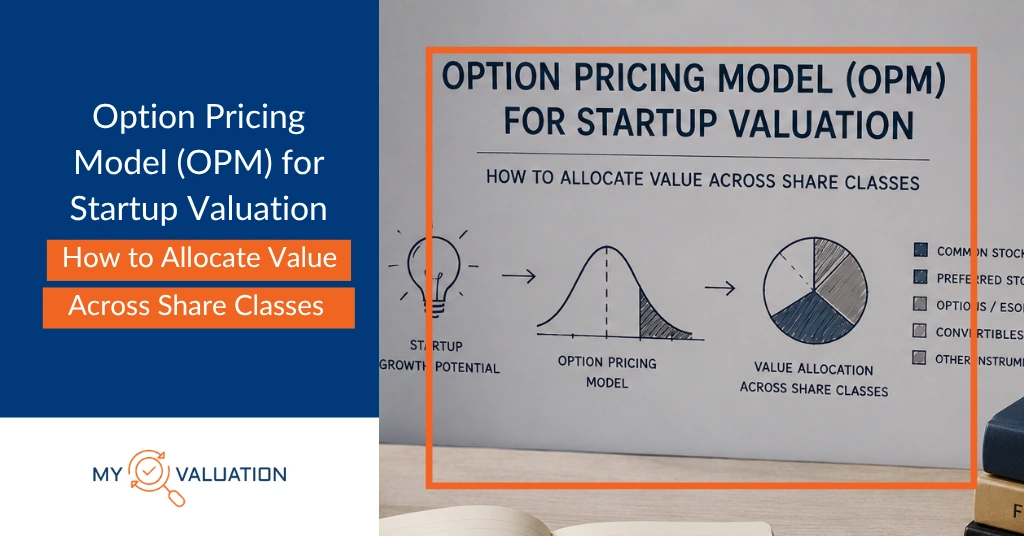
The option pricing model (OPM) is a method for splitting a company’s total equity value among share classes with different rights. It treats every class as a call option on enterprise value, exercisable at the point where that class starts getting paid.
The logic is straightforward once you see it. Common shareholders receive nothing until every preference above them has been satisfied. That payoff profile – worth zero below a threshold, worth something above it – is exactly a call option.
The framework comes from the AICPA’s Valuation of Privately-Held-Company Equity Securities Issued as Compensation, known in practice as the cheap stock guide. Indian valuers apply the same mechanics under Ind AS 113 fair value measurement.
Three terms recur throughout this guide. A breakpoint is an equity value at which the set of participating classes changes. The waterfall is the payout order those breakpoints describe. DLOM is the discount for lack of marketability, applied after allocation to reflect that private shares cannot be sold on demand.
Why Does Common Stock Sit Below the Preferred Share Price?
Common stock is worth less per share than preferred because preferred holders get paid first in every downside scenario. The gap is structural, not a discount someone chose to apply.
Take a company that raises Series B at ₹600 per share on a ₹600 crore post-money valuation. Two years later the market cools and the business is worth ₹200 crore. The Series B investor still recovers their full ₹78 crore before common sees a rupee.
This is why the shortcut fails. Dividing ₹200 crore by one crore fully diluted shares gives ₹200 per share and applies that figure to everyone. It quietly assumes every class ranks equally, which is precisely what how CCPS liquidation preference and anti-dilution terms are structured is designed to prevent.
How Does the OPM Allocate Value Across Share Classes?
The allocation runs in five steps. Each one is mechanical; the judgement sits in the inputs.
Step 1 – Establish total equity value
Derive enterprise value using an income, market or asset approach, then deduct net debt. For a recently funded startup, the backsolve described below is usually the more defensible route.
Step 2 – Build the breakpoint schedule
Work up the waterfall from zero. Each liquidation preference, each option strike price and each conversion indifference point creates a breakpoint. Build this from the signed shareholders’ agreement, not the summary cap table.
Step 3 – Value a call option at each breakpoint
Run Black-Scholes with the breakpoint as the strike price and total equity value as the underlying. A zero-strike call equals total equity value, which is what makes the tranches reconcile.
Step 4 – Allocate each incremental tranche
Subtract each call value from the one below it. The difference is the value of that tranche, and it is shared only among the classes participating in that band, pro rata to their shares.
Step 5 – Divide by shares and apply DLOM
Total each class’s allocated value, divide by its share count, then apply a marketability discount. The discount comes last, after allocation, never as a substitute for it.
A Worked Example: Allocating ₹200 Crore Across Four Share Classes
Consider an anonymised Bengaluru B2B SaaS company with a ₹200 crore total equity value and one crore fully diluted shares.
The stack: 60,00,000 common shares; a 12,00,000 option pool at a ₹50 strike; Series A CCPS of 15,00,000 shares carrying a ₹25 crore 1x non-participating preference; and Series B CCPS of 13,00,000 shares carrying a ₹78 crore 1x non-participating preference, senior to Series A.
That structure produces six breakpoints.
| Tranche | Equity value band | Who participates | Shares sharing |
| 1 | ₹0 – ₹78 cr | Series B preference only | – |
| 2 | ₹78 – ₹103 cr | Series A preference only | – |
| 3 | ₹103 – ₹133 cr | Common only | 60,00,000 |
| 4 | ₹133 – ₹217 cr | Common plus options | 72,00,000 |
| 5 | ₹217 – ₹594 cr | Above plus Series A converted | 87,00,000 |
| 6 | Above ₹594 cr | All classes as converted | 1,00,00,000 |
Breakpoint 3 sits at ₹103 crore, where both preferences are satisfied. Breakpoint 4 sits at ₹133 crore, because the options clear their ₹50 strike only once common has absorbed a further ₹30 crore. Breakpoint 5 is where Series A prefers converting to holding its preference.
Running Black-Scholes at each breakpoint with a four-year term, 55% volatility and a 6.8% risk-free rate gives call values of ₹200.0, ₹148.0, ₹135.4, ₹122.3, ₹94.7 and ₹40.3 crore. The differences are the tranche values, and they sum back to ₹200 crore exactly.
| Share class | Allocated value | Per share | Versus ₹200 shortcut |
| Series B CCPS | ₹57.3 cr | ₹440 | +120% |
| Series A CCPS | ₹28.0 cr | ₹187 | -7% |
| Common equity | ₹97.8 cr | ₹163 | -19% |
| ESOP options | ₹16.9 cr | ₹141 | – |
Common comes out at ₹163 against the ₹200 shortcut – 19% lower before any marketability discount. Apply a 20% DLOM and the defensible common value is roughly ₹130 per share, 78% below the ₹600 the Series B investor paid.
That gap is not aggressive valuation. It is what the shareholders’ agreement says, expressed in numbers.
Does Your Cap Table Need a Breakpoint Schedule Built from Scratch?
We build the waterfall from your signed shareholders’ agreement, run the allocation across every class, and document each assumption so your auditor can follow the arithmetic line by line. Reports covering CCPS, warrants and convertible structures are delivered in five to seven business days from complete documents.
Explore Our Valuation of Complex Financial InstrumentsWhat Is the OPM Backsolve and When Should You Use It?
The OPM backsolve runs the allocation in reverse. Instead of assuming a total equity value, it solves for the value at which the allocated per-share price of the newest preferred class equals the price that investor just paid.
A headline post-money valuation is not a fair value measurement. Multiplying the Series B price by all shares outstanding applies preferred economics to common shares that do not have them.
In the example above, ₹600 per share across one crore shares would imply ₹600 crore of equity value. The backsolve asks a different question: at what total equity value does Series B allocate to exactly ₹600 per share? The answer is materially lower, and it is the figure a statutory auditor will accept.
Use the backsolve when a priced round closed within roughly twelve months at arm’s length between unrelated parties. It is unreliable for insider rounds, bridge financings and structured deals – the same caution that applies to how convertible notes dilute the cap table before a priced round.
Which Inputs Drive an OPM, and Where Do Indian Valuers Get Them?
Five inputs drive every OPM. Two of them do most of the work.
| Input | Typical Indian source | Effect on common value |
| Total equity value | Backsolve from latest priced round, or DCF and market approach | Scales every class |
| Time to liquidity | Board’s exit horizon; commonly three to five years | High – longer terms lift common |
| Volatility | Listed Indian sector comparables, look-back matched to the term | High – higher volatility lifts common |
| Risk-free rate | Government of India zero-coupon yield at matching tenor | Low |
| Dividend yield | Usually nil for growth-stage companies | Low |
Volatility and time to liquidity deserve the scrutiny. Both lift the value of common stock, because a wider distribution of outcomes raises the chance of clearing the preference stack. Two disciplines keep this defensible. Match the volatility look-back window to the option term – a four-year term needs four years of comparable data, not one. And choose comparables on business model and stage rather than sector label, since a listed IT services company is a poor volatility proxy for an early-stage SaaS business.
Not Sure Whether OPM, PWERM or a Hybrid Fits Your Stage?
Our IBBI Registered Valuers assess your cap table, funding history and exit horizon before selecting an allocation method, then justify that selection inside the report itself. Method choice is part of the engagement, not something you have to decide before you call us.
See Our Startup Valuation Services in IndiaHow Does the OPM Result Set Your ESOP Strike Price?
The value allocated to common stock, after DLOM, is the fair market value anchoring your ESOP strike price. In the worked example that is roughly ₹130 per share – not ₹200, and certainly not ₹600.
For financial reporting, this feeds the grant-date fair value measurement under Ind AS 102. The allocated common value becomes the underlying share price in the option pricing model used to value the options themselves. Two option models, running in sequence, for two different purposes.
Here is where finance teams get caught. The Ind AS 102 allocation is not the same deliverable as the fair market value certificate required for perquisite tax on exercise. Those are separate exercises, on different valuation dates, under different professional requirements – and one cannot be substituted for the other.
Founders often assume a single valuation report covers accounting, tax and FEMA. It does not. Each has its own standard, date convention and signing authority, which is why our ESOP valuation services scope the purpose before the method.
When Does the OPM Break Down, and What Goes Wrong?
OPM assumes exit outcomes follow a single continuous log-normal distribution. Real startups face lumpy, discrete futures – a term sheet on the table, a regulatory approval pending, a founder dispute unresolved.
When a specific near-term event dominates the outlook, OPM smooths away exactly the information that matters. The alternative is the probability weighted expected return method, or a hybrid running OPM inside each scenario – the trade-offs are covered in our CCPS guide.
Four mistakes recur. Participating preferences and full ratchet anti-dilution get a standard template instead of a bespoke breakpoint structure. Volatility carried forward from a prior year quietly distorts every class. Allocations are not re-run after a new round, leaving earlier classes stale. And an OPM gets built for a single-class cap table, where there is nothing to allocate.
One trap deserves its own warning. An OPM allocation is not a pricing floor for regulatory purposes. Under Rule 21 of the FEMA (Non-debt Instruments) Rules 2019, shares issued to a non-resident must price at or above fair market value for the instrument being issued. An allocated common value cannot justify issuing CCPS below that floor.
Conclusion: Getting the Option Pricing Model for Startup Valuation Right
The option pricing model for startup valuation does one job well: it divides an established equity value among classes whose rights genuinely differ. Get the breakpoints right and the allocation follows mechanically. Get them wrong and every downstream number – strike price, accounting charge, investor reporting – inherits the error.
Four things to act on:
- Backsolve to equity value from the most recent arm’s length priced round rather than plugging in the headline post-money figure.
- Build the breakpoint schedule from the signed shareholders’ agreement, because summary cap tables omit the conversion and participation terms that create breakpoints.
- Keep the Ind AS 102 measurement and the tax FMV certificate as two separate deliverables with their own valuation dates.
- Re-run the allocation at every new round – a new senior preference resets the value of every class already on the stack.
Get those four right and your cap table stops being something you defend in every audit and starts being something you can plan against.
Need an Allocation Your Auditor, Your Investors and the Tax Department Will All Accept?
Talk to an IBBI Registered Valuer about your share class allocation, your ESOP strike price, and the separate certificates each regulator expects to see. The first consultation is free and covers scope, method and timeline before any engagement begins.
Book a Free Consultation with an IBBI Registered ValuerFrequently Asked Questions
1. What is the option pricing model in startup valuation?
It is a method that allocates a startup’s total equity value across share classes by treating each class as a call option on enterprise value. It allocates value that has already been determined; it does not determine that value.
2. Is the OPM the same as Black-Scholes?
No. Black-Scholes is the formula used inside the OPM to value the call option at each breakpoint. The OPM is the wider framework that builds the breakpoint schedule and distributes the resulting tranches.
3. What is a breakpoint in an OPM?
A breakpoint is an equity value at which the set of classes sharing further value changes. Liquidation preferences, option strike prices and conversion indifference points each create one.
4. How is the OPM backsolve different from post-money valuation?
Post-money multiplies the latest round price by all shares outstanding, applying preferred economics to common. The backsolve solves for the equity value at which the new preferred class allocates to its actual issue price, which is almost always lower.
5. Why is common stock worth less than preferred stock in the same company?
Preferred holders recover their liquidation preference before common receives anything, so common absorbs the first loss in any downside exit. That structural difference in risk shows up as a lower per-share value.
6. Can an OPM allocation be used for FEMA pricing compliance?
No. Rule 21 of the FEMA (Non-debt Instruments) Rules 2019 sets a fair market value floor for the specific instrument being issued to a non-resident. An allocated common value does not satisfy that requirement for a preference share issuance.
7. What volatility should an Indian startup OPM use?
Volatility is normally derived from listed Indian comparables selected on business model and stage, with the look-back window matched to the assumed time to liquidity. A four-year term calls for four years of comparable price history.
8. Does the OPM apply if my company has only one class of shares?
No. With a single class there is nothing to allocate, so the equity value divides directly across the shares. An OPM becomes necessary once preference shares, warrants or structured instruments enter the cap table.