
 Parth Shah
on
Parth Shah
on

Parth Shah
Register Valuer | CA | CPA | 15+ Years of Experiance
Parth Shah is the Founder and Team Leader of the company, bringing extensive expertise in business valuation and financial advisory.
Introduction
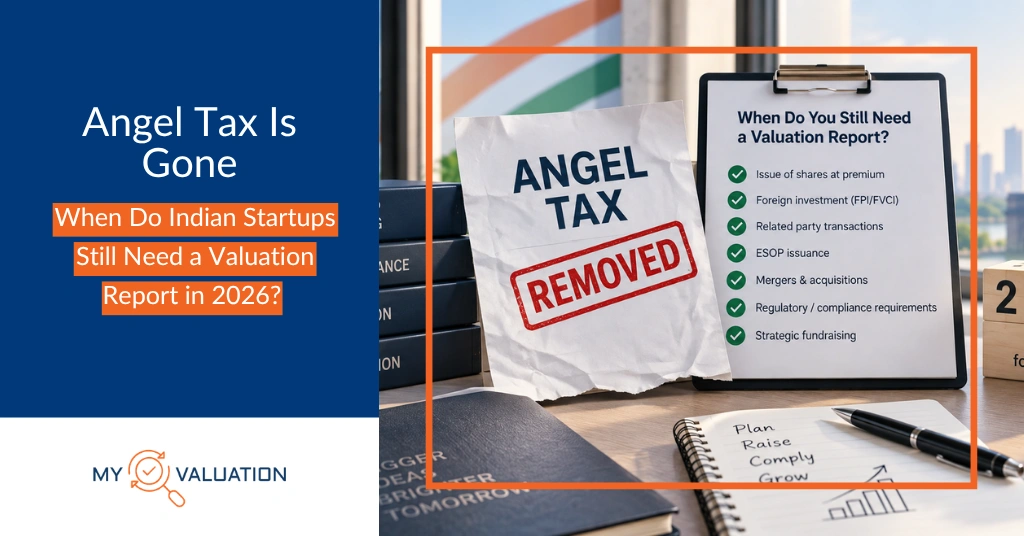
Angel tax is gone, but that does not mean every valuation requirement disappeared with it.
Section 56(2)(viib) of the Income-tax Act, 1961 was the provision commonly known as angel tax. It could bring share premium received by certain closely held companies above prescribed fair market value into the company’s taxable income. The Government made that provision inapplicable from April 1, 2025, corresponding to Assessment Year 2025-26. The Ministry of Finance subsequently confirmed in Parliament that the angel-tax provisions had been sunset and that the valuation rules relating specifically to that provision no longer applied.
That change removed one major tax-driven reason startups obtained valuations before issuing shares. It did not repeal the Companies Act, FEMA pricing rules, ESOP valuation requirements or the current income-tax provisions governing certain below-FMV transfers and receipts of shares.
The Income-tax framework also changed again on April 1, 2026. The Income-tax Act, 2025 replaced the 1961 Act for Tax Year 2026-27 onward, while the repealed law continues to govern earlier tax years through the transition rules.
The practical question for founders is therefore no longer, “Do we need an angel-tax valuation?” It is, “Does this transaction create a valuation requirement under another law, or do we need a valuation for commercial decision-making even where no statute requires one?”
Key Takeaways
- Angel Tax Has Been Sunset: Section 56(2)(viib) was made inapplicable from April 1, 2025. A 2026 funding round should not automatically be scoped around the old angel-tax provision.
- Old Rule 11UA Angel-Tax Advice Can Be Stale: Do not order a legacy Section 56(2)(viib) report for a current round merely because older fundraising checklists say it is mandatory.
- Preferential Allotments Still Matter: An unlisted company issuing shares or convertible securities on a preferential basis can still require registered valuation under Companies Act Rule 13.
- Foreign Investment Still Has FEMA Pricing Rules: A foreign investor can create a FEMA floor, ceiling, certification and reporting requirement independently of angel tax.
- Secondary Transfers Still Have Tax FMV Rules: Under the Income-tax Act, 2025, Section 79 can substitute prescribed FMV for consideration when an unquoted share is transferred below that FMV, subject to the provision and applicable exceptions.
- The Recipient Can Also Have an FMV Issue: Section 92(2)(m) can apply when shares or securities are received without consideration or for inadequate consideration beyond the statutory threshold, subject to its exclusions and exemptions.
- ESOP Valuation Did Not Disappear: Employee equity continues to create separate valuation needs for tax and accounting purposes.
- Commercial Valuation and Statutory Valuation Are Different: A founder may still need a valuation to negotiate a round, model dilution or support investor discussions even when no particular statute mandates a report for that commercial exercise.
What Exactly Happened to Angel Tax?
Angel tax was not a tax on every startup valuation. It was a specific income-tax provision.
Old Section 56(2)(viib) addressed consideration received by certain closely held companies from the issue of shares where the issue price exceeded the fair market value determined under the applicable framework.
The Finance (No. 2) Act, 2024 made that provision inapplicable from April 1, 2025. In a December 2025 Rajya Sabha response, the Ministry of Finance expressly stated that Section 56(2)(viib) had been made inapplicable from April 1, 2025 and that, because the provision had been sunset, the valuation rules for the purposes of that section no longer applied.
The correct 2026 conclusion is therefore:
A startup does not need an angel-tax valuation solely to defend a current share premium under the old Section 56(2)(viib).
But that statement should not be expanded into:
“Startups no longer need valuation reports.”
That second statement is incorrect.
Does Every Startup Funding Round Still Require a Valuation Report?
No. A fundraising conversation and a statutory valuation requirement are not the same thing.
A startup may calculate or commission a valuation for commercial purposes to:
- set a fundraising range;
- compare investor offers;
- calculate dilution;
- support board decision-making;
- negotiate a pre-money valuation;
- analyze a complex capital structure; or
- prepare for investor due diligence.
That work can be valuable without being mandated by tax law.
A statutory valuation report, however, should be tied to an actual legal trigger. The relevant trigger may come from the Companies Act, FEMA, income tax, ESOP rules, accounting standards or another transaction-specific framework.
The following matrix separates these situations.
Startup Valuation Decision Matrix for 2026
| Transaction | Is Valuation Still Relevant? | Main Framework | Key Point |
| Commercial fundraising negotiation only | Often useful, not mandatory solely because of angel tax | Commercial | Supports negotiation and dilution analysis |
| Unlisted preferential allotment | Yes, where Rule 13 applies | Companies Act | Registered-valuer pricing requirement |
| Issue to foreign investor | Yes where FEMA pricing guidelines apply | FEMA / RBI | Unlisted-company pricing floor |
| Resident sells unquoted shares below prescribed FMV | Yes for tax computation | Income-tax Act, 2025 | Section 79 can deem FMV as consideration |
| Person receives shares below FMV | Potential tax valuation required | Income-tax Act, 2025 | Section 92(2)(m), subject to exclusions |
| Employee exercises ESOP | Separate valuation framework | Income tax | ESOP perquisite FMV rules |
| ESOP financial reporting | Separate accounting valuation | Ind AS / applicable accounting framework | Grant-date option valuation |
| Cross-border share swap | Yes | FEMA plus other applicable law | Special FEMA valuation signatory rule |
| Historic angel-tax dispute | Potentially yes | Repealed 1961 Act for relevant earlier tax year | Sunset does not erase prior-year proceedings |
The most important workflow change after angel tax is simple: identify the transaction first, then order the report.
Do Not Order a “Startup Valuation Report” Without Defining Its Legal Purpose
Define the transaction, valuation date, investor residency, instrument and intended use in the engagement scope before deciding which valuation framework applies.
Define Your Valuation RequirementsWhen Does the Companies Act Still Require Startup Valuation?
For many unlisted startups, the Companies Act is now one of the most important reasons a valuation report may still be required during fundraising.
Rule 13 of the Companies (Share Capital and Debentures) Rules, 2014 governs preferential offers by unlisted companies under the relevant Companies Act framework. It requires the price of shares or other securities issued on a preferential basis to be determined on the basis of a registered valuer’s report, and provides that the issue price shall not be less than the price determined through that report.
Convertible securities have additional timing provisions within Rule 13 concerning when the resultant share price is determined.
Section 247 of the Companies Act separately establishes the registered-valuer framework where valuation is required under the Act.
The critical point is that the disappearance of angel tax did not amend away these corporate-law provisions.
Commercial Pre-Money Value vs Companies Act Value
A ₹50 crore pre-money valuation appearing in a term sheet is a negotiated commercial number. It does not automatically become the statutory price required for a preferential allotment.
Likewise, a registered-valuer conclusion is not necessarily the same thing as the post-money headline used to describe the financing.
Founders who want to understand that distinction in deal terms can refer to My Valuation’s.
When Does FEMA Still Require Valuation?
Foreign investment is another major reason startup valuation survives the abolition of angel tax.
Under the RBI Master Direction updated through June 15, 2026, a fresh issue of equity instruments by an unlisted Indian company to a person resident outside India generally cannot be priced below the value determined using an internationally accepted pricing methodology on an arm’s-length basis. The same floor concept generally applies to a transfer from a resident to a non-resident, while a transfer from a non-resident to a resident is generally subject to a pricing ceiling.
For the ordinary unlisted-company cases, RBI permits certification by:
- a Chartered Accountant;
- a SEBI-registered Merchant Banker; or
- a practicing Cost Accountant.
A share swap has a separate rule requiring a SEBI-registered Merchant Banker or an appropriately regulated overseas Investment Banker.
This is independent of angel tax.
A foreign VC investing into an Indian startup can therefore require a FEMA pricing exercise even though Section 56(2)(viib) no longer applies.
Check Investor Residency Before Finalizing the Issue Price
A resident investor and a non-resident investor can create different statutory pricing workstreams, even when they are participating in the same commercial round.
Review Your Investor & Pricing RequirementsWhat Income Tax Valuation Rules Still Apply After Angel Tax?
This is where the phrase “angel tax is gone” causes the most confusion.
The abolition removed the old share-premium provision. It did not eliminate every fair-market-value rule for shares.
For Tax Year 2026-27 onward, the Income-tax Act, 2025 is the current statute. Two provisions are particularly relevant to private-share transactions.
Section 79: Seller-Side Rule for Unquoted Share Transfers
Section 79 applies where consideration received for the transfer of a share other than a quoted share is below the fair market value determined in the prescribed manner. In that case, subject to the section and prescribed exceptions, the FMV is deemed to be the full value of consideration for capital-gains purposes.
This is conceptually different from angel tax.
Angel tax concerned consideration received by the issuing company on issue of shares. Section 79 addresses the transfer of an existing unquoted share for capital-gains computation.
Section 92(2)(m): Recipient-Side Inadequate Consideration
Section 92(2)(m) can apply when a person receives specified property, including shares and securities, without consideration or for consideration below aggregate fair market value by more than the statutory threshold, subject to the exemptions and exclusions in the section.
For movable property received for inadequate consideration, the provision uses the ₹50,000 differential threshold specified in the section.
Again, this is not a revival of angel tax. It is a different current provision aimed at a different transaction and taxpayer.
What Does Rule 57 Do in 2026?
The Income-tax Rules, 2026 now prescribe current FMV mechanics for several provisions.
Rule 56 defines relevant expressions and valuation dates. Rule 57 sets out the method for determining fair market value of specified property. For unquoted equity shares covered by the relevant sections, the rule contains a prescribed adjusted net-asset formula based on assets, liabilities, paid-up equity capital and the paid-up value of the relevant share.
This point needs careful wording:
Rule 57 is not “the new angel-tax valuation rule.”
It serves current provisions such as those dealing with specified property and unquoted-share transactions. The Ministry of Finance has expressly confirmed that the valuation rules for the sunset angel-tax provision no longer apply for that purpose.
Companies should therefore avoid renaming every Rule 57 calculation an “angel-tax valuation.”
Illustrative Post-Angel-Tax Transaction Scenarios
The following examples are illustrative compliance maps only. They do not conclude whether a report is required in a real transaction without reviewing the actual facts.
Scenario 1: Resident Angel Investor in a Preferential Round
An unlisted Indian startup raises money from a resident investor.
The old angel-tax provision does not create a current Section 56(2)(viib) report requirement. However, if the issuance is structured as a preferential allotment covered by Rule 13, the Companies Act registered-valuer pricing requirement may still apply.
Result: Angel tax gone does not mean no Companies Act valuation.
Scenario 2: Foreign VC Invests in the Same Startup
Assume a person resident outside India subscribes to the startup’s equity instruments.
FEMA pricing can create an arm’s-length pricing floor. If the issue is also a preferential allotment by an unlisted company, Companies Act valuation may operate alongside FEMA.
Result: Two separate legal bases can affect the same round.
Scenario 3: Founder Sells Existing Shares at a Discount
Assume a founder sells unquoted shares to another person for less than the prescribed tax FMV.
Section 79 may affect the seller’s capital-gains computation, while Section 92(2)(m) may need to be checked for the recipient, subject in each case to the relevant conditions, thresholds and exceptions.
Result: Secondary-transfer FMV rules survived the end of angel tax.
Scenario 4: Company Grants and Employees Exercise ESOPs
Angel tax is irrelevant to the ESOP accounting and exercise-stage valuation questions.
ESOPs can require grant-date valuation for accounting and exercise-stage FMV analysis for employee taxation. My Valuation’s explains these separate measurements.
Match the Report to the Event, Not the Company
The same startup may need a Companies Act valuation in one month, a FEMA valuation in another and an ESOP valuation later. Keep the purpose and valuation date explicit in every report.
Find the Right Valuation for Your EventWhat About Historic Angel-Tax Cases?
The sunset is prospective in its operation and does not erase the tax framework applicable to earlier periods.
The Income Tax Department explains that when the Income-tax Act, 2025 took effect on April 1, 2026, the 1961 Act continued to govern tax years beginning before that date through the repeal-and-savings provisions. Pending assessments, appeals and other proceedings for earlier tax years therefore continue under the old framework.
A startup facing a historic Section 56(2)(viib) notice should not discard the valuation evidence supporting that earlier share issue merely because current rounds are no longer subject to the provision.
Historical DCF workings, forecasts, board papers, term sheets and contemporaneous information may remain relevant to the earlier proceeding.
Do Startups Still Need Valuation for Fundraising if No Law Requires It?
Often, yes, but that is a commercial valuation, not a statutory requirement.
A well-supported fundraising valuation can help founders:
- test the investor’s headline number;
- quantify dilution;
- compare term sheets;
- model ESOP pool expansion;
- understand preferred-security economics;
- assess whether forecasts support the negotiation range;
- plan the next fundraising milestone; and
- explain valuation assumptions during investor diligence.
The distinction should remain visible in the report.
A fundraising advisory valuation should not be marketed as an IBBI, FEMA, tax or SEBI statutory report unless it was actually prepared under that framework and by the appropriate professional.
Likewise, a statutory minimum price should not automatically be presented to founders as the amount an investor ought to pay.
SEBI Rules Still Matter Where the Startup or Transaction Falls Within SEBI’s Framework
Angel-tax abolition also did not remove SEBI regulation.
For listed issuers, RBI’s foreign-investment pricing directions themselves point to applicable SEBI pricing guidelines. SEBI’s current regulatory library lists the SEBI (Issue of Capital and Disclosure Requirements) Regulations, 2018 as last amended on March 21, 2026.
Other SEBI frameworks can become relevant depending on the company, investor, instrument or transaction.
The safe editorial rule is not to transplant private-company Companies Act or tax valuation language into a listed-company transaction. Identify the applicable SEBI regulation first.
A 2026 Decision Tree: Do You Need a Valuation Report?
Use this sequence before appointing a valuer:
- Identify the event. Is this fundraising, preferential allotment, secondary transfer, ESOP, conversion, share swap, restructuring or another transaction?
- Identify the parties. Are the investor, buyer or seller resident or non-resident?
- Identify the company. Listed or unlisted, and which sector?
- Identify the law. Companies Act, FEMA, Income-tax Act, SEBI, accounting rules or more than one?
- Identify the value required. Commercial equity value, statutory issue price, FEMA floor/ceiling, tax FMV, option fair value or another measure?
- Identify the valuation date. The legal trigger should determine the date, not convenience.
- Identify the permitted professional. Registered Valuer, CA, Merchant Banker, Cost Accountant or another category depending on the rule.
- Then choose the methodology. Do not start with “DCF or NAV?” before the first seven questions are answered.
This sequence prevents the most expensive valuation mistake: receiving a technically polished report prepared for the wrong purpose.
Common Post-Angel-Tax Valuation Mistakes
Assuming valuation is no longer required anywhere. The angel-tax provision was only one of several valuation frameworks.
Continuing to order Section 56(2)(viib) reports for current rounds. The Ministry of Finance has confirmed that the provision and its associated valuation rules no longer apply for that purpose.
Calling every Rule 57 calculation an angel-tax valuation. Rule 57 now supports other current tax provisions.
Ignoring Companies Act Rule 13. A resident-only preferential round can still have a registered-valuer requirement.
Ignoring FEMA because angel tax disappeared. Foreign-investment pricing has an independent regulatory basis.
Using one valuation report for tax, FEMA, Companies Act and ESOP purposes without checking scope. Different rules can use different dates, signatories and measures of value.
Treating statutory FMV as the negotiated fundraising valuation. Compliance value and investment negotiation serve different decisions.
Deleting historical valuation files. Old tax years and proceedings remain governed by the law applicable to those periods.
Why My Valuation?
My Valuation is an IBBI Registered Valuer-led valuation and financial advisory firm. The post-angel-tax environment makes correct scoping more important, not less.
A startup may no longer need a valuation for the old Section 56(2)(viib), yet the same financing can still involve Companies Act pricing, FEMA rules, complex security valuation, cap-table modeling or employee-equity valuation.
The starting point should therefore be the transaction rather than a pre-selected report name. A useful valuation scope identifies the legal or commercial purpose, valuation date, instrument, permitted professional and intended user before selecting the model.
That approach also reduces the risk of paying for a report that answers a technically valid question but not the question required by the transaction.
Get the Scope Right Before Paying for the Report
If you have been told that a valuation is “mandatory,” ask for the exact transaction, law, provision, valuation date and professional requirement before commissioning it.
Clarify Your Valuation ScopeConclusion
Angel tax is gone. Valuation is not.
The old Section 56(2)(viib) no longer creates a current valuation requirement for share premium simply because an Indian startup raises at a price above tax FMV. That is a meaningful reduction in fundraising friction.
But other valuation frameworks continue to operate independently.
An unlisted preferential allotment can require registered valuation under the Companies Act. Foreign investment can trigger FEMA pricing rules. Secondary transfers can interact with Sections 79 and 92 of the Income-tax Act, 2025. Employee equity has its own accounting and tax valuation framework. Listed-company transactions can bring SEBI pricing requirements into the analysis.
The correct 2026 question is therefore not, “Do startups still need valuation reports?” It is, “Which valuation does this specific transaction require, if any?”
This article provides general educational information and does not constitute personalized legal, tax, accounting or investment advice. Transaction-specific requirements should be reviewed with appropriately qualified professionals before implementation.
Frequently Asked Questions
1. Is angel tax completely gone in India in 2026?
For current rounds, the old Section 56(2)(viib) angel-tax provision was made inapplicable from April 1, 2025. The Ministry of Finance has confirmed that the provision has been sunset and its valuation rules no longer apply for that purpose. Earlier tax years and proceedings remain subject to the applicable legacy framework.
2. Do startups still need Rule 11UA valuation after angel tax?
Do not use old Rule 11UA references automatically for a current 2026 transaction. The Income-tax Act, 2025 and Income-tax Rules, 2026 apply for Tax Year 2026-27 onward, and current Rule 57 contains FMV mechanics relevant to specified surviving provisions. The old angel-tax valuation regime should not be carried into current rounds simply because older templates still mention it.
3. Does a resident-only startup funding round still need an IBBI Registered Valuer?
It can, depending on the legal route used for the issue. An unlisted preferential allotment covered by Rule 13 of the Companies (Share Capital and Debentures) Rules requires pricing based on a registered valuer’s report. A pure commercial valuation discussion, by contrast, is not automatically a statutory registered-valuer assignment merely because investors are negotiating a pre-money value.
4. Does foreign investment still require a valuation after angel tax?
FEMA pricing rules operate independently of angel tax. For an unlisted Indian company, a fresh issue to a non-resident generally has an arm’s-length pricing floor under the current RBI framework, subject to the specific transaction and applicable exceptions.
5. Can founders sell shares below fair market value in 2026?
The tax implications need to be checked carefully. Section 79 of the Income-tax Act, 2025 can deem prescribed FMV to be the seller’s consideration where an unquoted share is transferred below FMV, subject to the provision’s conditions and exceptions. Section 92 may also be relevant to the recipient in an inadequate-consideration transaction.
6. Is Rule 57 the replacement for angel tax?
No. Rule 57 contains current FMV methods for specified provisions of the Income-tax Act, 2025. It should not be described as a replacement angel-tax provision because the Government has confirmed that the old angel-tax framework itself was sunset.
7. Are ESOP valuations still required after angel tax?
Angel-tax abolition did not remove ESOP accounting or employee-tax valuation requirements. Depending on the company and event, ESOPs can involve grant-date option fair value for accounting and separate exercise-stage FMV for tax.
8. Should a startup still obtain a valuation before fundraising if no law requires it?
It can be commercially useful. An independent valuation can help test assumptions, compare term sheets, model dilution and explain a fundraising range, but it should be clearly described as commercial or advisory work rather than presented as a statutory report if no statutory trigger applies.