
ESOP Accounting
Graded Vesting vs Cliff Vesting ESOPs under Ind AS 102: One Grant, Two Structures, Two Very Different Expense Profiles
- Ind AS 102 ESOP Accounting
- Compare Two Expense Profiles
Introduction
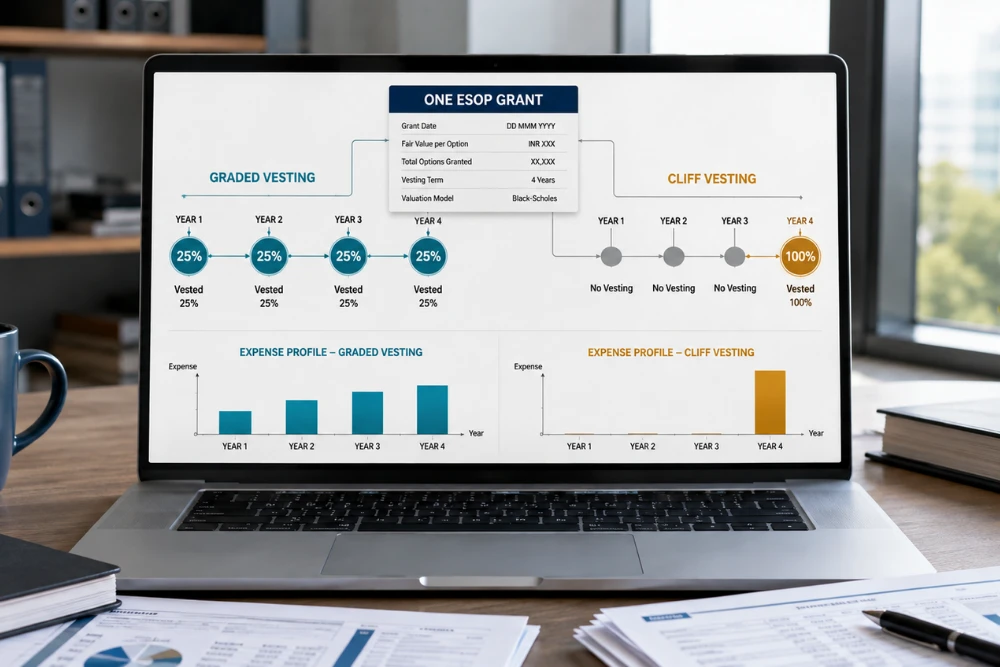
The single most common error we see in ESOP workings is a graded vesting grant valued and expensed as though it were a cliff vesting grant. This worked example takes the same number of options, the same strike price and the same share price, changes only the vesting pattern, and shows exactly how far apart the two answers land.
Everything below is a hypothetical illustration. The figures are constructed to demonstrate the mechanics and do not relate to any client engagement.
First, The Terminology
The two structures differ in one respect only - how many dates the options vest on.
| Cliff Vesting (Non-Graded) | Graded Vesting | |
|---|---|---|
| Vesting dates | One | Two or more |
| Typical pattern | 100% vests at the end of a stated period, say three years | The grant vests in instalments - for example one-third at the end of each of Years 1, 2 and 3 |
| Ind AS 102 views | A single grant with a single vesting period | Each instalment is treated as a separate grant with its own vesting period |
| Number of option valuations required | One | One per tranche |
Why Ind As 102 Splits A Graded Grant Into Tranches
Under Ind AS 102, an equity-settled share-based payment is measured at the grant-date fair value of the instruments granted and recognised as an expense over the period the employee renders the related service - the vesting period.
When a grant vests in instalments, the employee is not rendering one service period. The employee earns the first instalment over one year, the second over two years, and the third over three. The standard's implementation guidance accordingly treats each instalment as a separate share-based payment arrangement, each with its own vesting period, its own expected life, and therefore its own fair value.
A cliff grant has one service period and one exercise window, so one valuation and a straight-line charge across the vesting period is correct. The difference is not a matter of preference or materiality - the two structures are simply different arrangements.
The Hypothetical: Identical In Every Respect Except Vesting
Assume a listed Indian company grants employee stock options on 1 April 2025. All parameters below are held constant across both scenarios.
| Parameter | Assumption |
|---|---|
| Options granted | 1,20,000 |
| Share price at grant date (S) | ₹100 |
| Exercise price (K) | ₹100 |
| Expected volatility (σ) | 40% per annum |
| Expected dividend yield (q) | Nil |
| Exercise period | 3 years from each vesting date |
| Risk-free rate (r) | Read off the sovereign yield curve at the tenor matching each expected life - 6.50% at 2.5 years, 6.70% at 3.5 years, 6.90% at 4.5 years |
| Model | Black-Scholes-Merton |
| Scenario | Vesting Pattern |
|---|---|
| Scenario A - Cliff | 100% (1,20,000 options) vest on 31 March 2028, three years from grant |
| Scenario B - Graded | 40,000 options vest on each of 31 March 2026, 2027 and 2028 |
Step 1: Expected Life Is Where The Two Scenarios Separate
An employee cannot exercise before vesting and cannot exercise after the exercise period ends. Expected life under the midpoint method is the midpoint of that window, measured from the grant date.
| Scenario / Tranche | Vests At (Years) | Exercise Window Ends (Years) | Expected Life |
|---|---|---|---|
| Scenario A - Cliff (all options) | 3 | 6 | 4.5 years |
| Scenario B - Tranche 1 | 1 | 4 | 2.5 years |
| Scenario B - Tranche 2 | 2 | 5 | 3.5 years |
| Scenario B - Tranche 3 | 3 | 6 | 4.5 years |
Note the last two rows. Tranche 3 of the graded grant has exactly the same expected life as the entire cliff grant - because they vest on the same date. What differs is that under cliff vesting, all 1,20,000 options carry that 4.5-year life, whereas under graded vesting only 40,000 do.
Step 2: Fair Value Per Option
Applying Black-Scholes-Merton with the inputs above produces the following. The longer the expected life, the higher the option value - more time value, and a larger discount on the present value of the exercise price.
| Expected Life | Risk-Free Rate | D1 | D2 | Fair Value Per Option | |
|---|---|---|---|---|---|
| Cliff (all options) | 4.5 years | 6.90% | 0.7902 | (0.0583) | ₹43.58 |
| Graded - Tranche 1 | 2.5 years | 6.50% | 0.5732 | (0.0593) | ₹31.18 |
| Graded - Tranche 2 | 3.5 years | 6.70% | 0.6875 | (0.0608) | ₹37.78 |
| Graded - Tranche 3 | 4.5 years | 6.90% | 0.7902 | (0.0583) | ₹43.58 |
Step 3: Total Cost Of The Grant
| Scenario | Options | Fair Value Per Option | Cost |
|---|---|---|---|
| Scenario A - Cliff (single grant) | 1,20,000 | ₹43.58 | ₹52,29,600 |
| Scenario B - Tranche 1 | 40,000 | ₹31.18 | ₹12,47,200 |
| Scenario B - Tranche 2 | 40,000 | ₹37.78 | ₹15,11,200 |
| Scenario B - Tranche 3 | 40,000 | ₹43.58 | ₹17,43,200 |
| Scenario B - Graded, total | 1,20,000 | ₹45,01,600 |
The first insight: the graded grant is cheaper. Total cost is ₹45,01,600 against ₹52,29,600 - about 14% lower - even though the number of options, the strike price and the share price are identical. Two-thirds of the graded options carry a shorter expected life, and shorter-dated options are worth less.
Step 4: Spreading The Cost - Where The Profiles Diverge Sharply
Scenario A is straightforward. One grant, one three-year vesting period, cost recognised evenly across it.
| Scenario A - Cliff | Year 1 | Year 2 | Year 3 | Total |
|---|---|---|---|---|
| Expense for the year | ₹17,43,200 | ₹17,43,200 | ₹17,43,200 | ₹52,29,600 |
| Cumulative | ₹17,43,200 | ₹34,86,400 | ₹52,29,600 | |
| % of total recognised | 33.3% | 66.7% | 100.0% |
Scenario B requires each tranche to be spread over its own vesting period, all three starting from the grant date. Tranche 1 is recognised entirely in Year 1; Tranche 2 across Years 1 and 2; Tranche 3 across Years 1, 2 and 3.
| Scenario B - Graded | Year 1 | Year 2 | Year 3 | Total |
|---|---|---|---|---|
| Tranche 1 (₹12,47,200 over 1 year) | ₹12,47,200 | - | - | ₹12,47,200 |
| Tranche 2 (₹15,11,200 over 2 years) | ₹7,55,600 | ₹7,55,600 | - | ₹15,11,200 |
| Tranche 3 (₹17,43,200 over 3 years) | ₹5,81,067 | ₹5,81,067 | ₹5,81,066 | ₹17,43,200 |
| Expense for the year | ₹25,83,867 | ₹13,36,667 | ₹5,81,066 | ₹45,01,600 |
| Cumulative | ₹25,83,867 | ₹39,20,534 | ₹45,01,600 | |
| % of total recognised | 57.4% | 87.1% | 100.0% |
The second insight, and the one that catches finance teams out: the graded grant costs less in total but costs far more in Year 1. ₹25,83,867 against ₹17,43,200 - roughly 48% higher - and by the end of Year 1 the company has already recognised 57.4% of the graded grant's cost against 33.3% of the cliff grant's. A budget built on a straight-line assumption would understate the first year's employee benefit expense by more than ₹8 lakh on a grant of this size.
What The Common Shortcut Would Have Produced
Suppose the graded grant had been valued as one option at ₹43.58 and expensed straight-line over three years - the treatment we most often find in workings prepared without tranche-level analysis.
| Treatment | Year 1 expense | Total cost |
|---|---|---|
| Correct treatment (graded, tranche-wise) | ₹25,83,867 | ₹45,01,600 |
| Common shortcut (single value, straight-line) | ₹17,43,200 | ₹52,29,600 |
| Misstatement | Year 1 understated by ₹8,40,667 | Total overstated by ₹7,28,000 |
The Accounting Entries
The entries themselves are identical in form; only the amounts change. In each year of the vesting period:
- Employee benefits expense (share-based payment)
- To Share-based payment reserve (equity)
On exercise, the amount received from the employee is recorded together with the reserve balance attributable to the exercised options, credited to share capital at face value and the balance to securities premium. If options lapse after vesting, the standard does not permit a reversal of the expense already recognised - the balance is typically transferred within equity, generally to general reserve or retained earnings, in line with the company's accounting policy.
Forfeitures: Graded Vesting Means Tranche-level Tracking
Under both structures, the grant-date fair value per option is fixed and never remeasured. What is revised at each reporting date is the estimate of how many options are expected to vest, based on service and non-market conditions, with a corresponding true-up of the cumulative expense.
Under cliff vesting, an employee who leaves in Year 2 forfeits the entire award, and the whole cumulative expense for that employee reverses. Under graded vesting, the same departure leaves Tranche 1 already vested and unaffected, while Tranches 2 and 3 are forfeited. The reversal is partial and must be computed tranche by tranche - which means the expense schedule has to be maintained at tranche level, not just at grant level, for the whole vesting period.
A Note For Groups Reporting Under Both Ind As And Us GAAP
ASC 718 permits an entity to make an accounting policy election to recognise the cost of an award with graded vesting and only service conditions on a straight-line basis over the total vesting period, subject to a floor. Ind AS 102 contains no equivalent election.
This matters in practice because ESOP templates and group accounting manuals built for a US parent frequently carry the straight-line assumption into the Indian subsidiary's books, where it is not available. If your working paper spreads a graded grant evenly across the vesting period, that is the first thing to check.
A Short Review Checklist
- Count the fair values. If the scheme vests in instalments, there must be one fair value per instalment, not one for the grant.
- Check the expected lives differ. Each tranche's expected life should be the midpoint of its own exercise window from the grant date - they should not be identical.
- Match the risk-free rate to each expected life. Reading a single long-tenor benchmark across every tranche overstates the rate on the short ones.
- Look at the shape of the expense schedule. For a graded grant the profile must be front-loaded. An even spread is a red flag under Ind AS 102.
- Confirm the forfeiture true-up is at tranche level. Cumulative expense at each reporting date should tie to the number of options currently expected to vest, tranche by tranche.
Frequently Asked Questions
Need your ESOP working reviewed, or a valuation prepared?
My Valuation is an IBBI Registered Valuer firm. We prepare ESOP and share-based payment valuations under Ind AS 102 for listed and unlisted Indian companies, and we review workings prepared elsewhere before they reach the auditor.