 Parth Shah
on

Parth Shah
Registered Valuer | CA | CPA | 15+ Years of Experience
Parth Shah is the Founder and Team Leader of the company, bringing extensive expertise in business valuation and financial advisory.
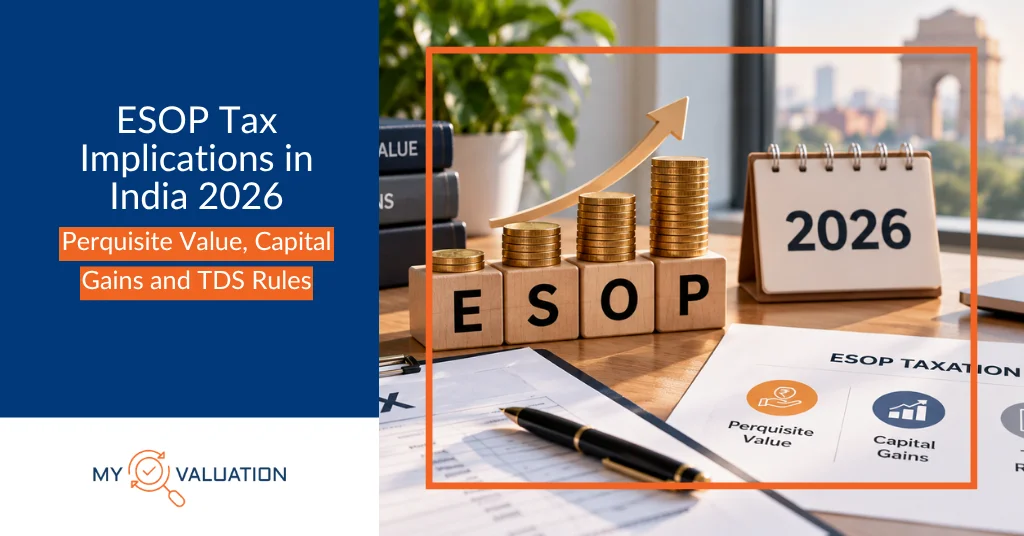
The ESOP tax implications in India in 2026 come down to two taxes. When you exercise your options, the gap between the share’s fair market value and your exercise price is taxed as salary. When you later sell the shares, the profit above that fair market value is taxed as capital gains. Nothing is taxed at grant or at vesting.
From 1 April 2026, these rules sit in the Income-tax Act 2025 and the Income-tax Rules 2026. The logic is the same as before, but the section numbers have changed and the startup deferral window has grown. At MyValuation, we prepare the exercise-date valuations that drive this tax, so this guide focuses on what employees and founders actually need to get right.
Key Takeaways
- ESOP tax implications in India 2026: ESOPs are taxed twice, first as a salary perquisite on exercise and then as capital gains on sale, with no tax at grant or vesting.
- The perquisite equals FMV on the exercise date minus the exercise price, now taxed under section 17(1)(d) of the Income-tax Act 2025.
- For unlisted shares, FMV must come from a SEBI Category I merchant banker, valued on a date no more than 180 days before exercise (Rule 15).
- Your employer deducts TDS under section 392 on the perquisite, even though you receive shares, not cash.
- Employees of startups holding an IMB certificate can defer the exercise tax for up to 60 months after the tax year of allotment.
- On sale, your cost is the exercise-date FMV, and the holding period runs from the date of allotment.
When Are ESOPs Taxed in India?
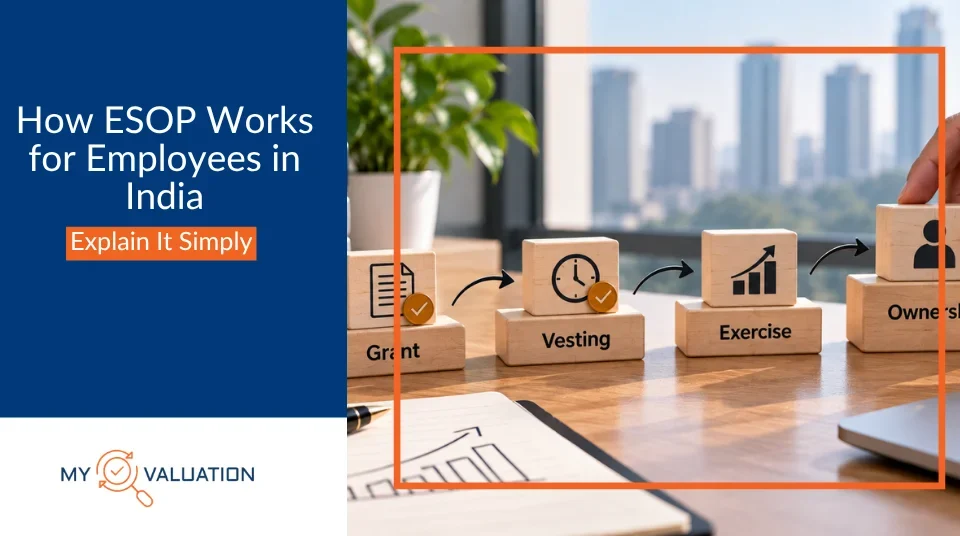
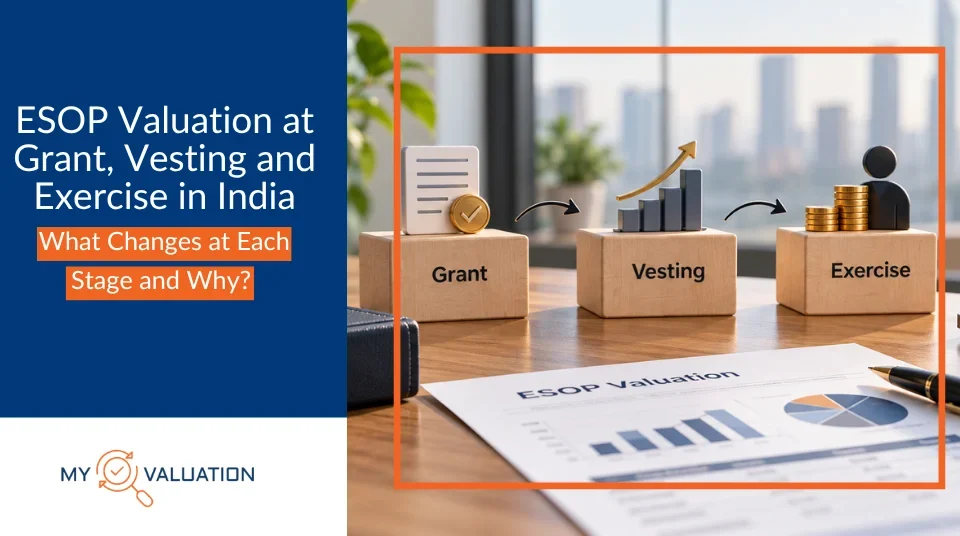
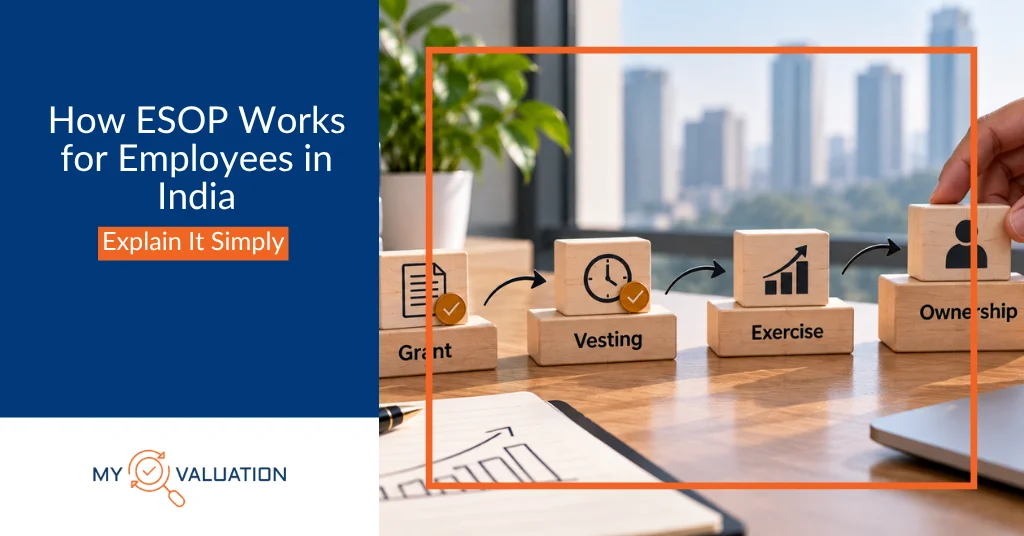
ESOPs are taxed only at two points: exercise and sale. Grant and vesting give you a right, not an asset, so no income arises. The table below shows the full lifecycle.
| Stage | What happens | Tax? |
| Grant | Company offers options at a fixed price | No |
| Vesting | You earn the right to buy | No |
| Exercise | You pay and receive shares | Yes, as salary (perquisite) |
| Sale | You sell the shares | Yes, as capital gains |
A perquisite is a non-cash benefit from your employer that counts as salary. Because it is salary, it is taxed at your slab rate, which for most senior startup employees means the top rate.
What Changed for ESOP Taxation Under the Income-tax Act 2025?
The core rule did not change in 2026. What changed is where the rules live and how long eligible startup employees can defer the tax. If your plan documents, offer letters or payroll notes still quote the old sections, they need updating.
| Item | Old law (1961 Act) | New law (2025 Act) |
| Perquisite provision | Section 17(2)(vi) | Section 17(1)(d) |
| FMV valuation rule | Rule 3(8) | Rule 15 |
| TDS on salary | Section 192 | Section 392 |
| Startup deferral | Section 192(1C) | Section 392(3) with 289(3) |
| Startup eligibility | Section 80-IAC | Section 140 |
| Deferral window | 48 months | 60 months |
The “assessment year” and “previous year” are also gone. The new Act uses a single tax year, so tax year 2026-27 runs from 1 April 2026 to 31 March 2027.
How Is ESOP Perquisite Value Calculated in India?
The ESOP perquisite value is the fair market value (FMV) of the shares on the exercise date, minus the price you paid, multiplied by the number of shares. FMV here means the value the tax law prescribes, not a figure the company picks.
The formula is simple: Perquisite = (FMV on exercise date − exercise price) × number of shares. The hard part is the FMV, and Rule 15 of the Income-tax Rules 2026 sets out how to find it.
Listed shares: average of opening and closing price
For shares listed on a recognised Indian stock exchange, FMV is the average of the opening and closing price on the exercise date. If the shares trade on more than one exchange, use the one with the higher trading volume. If there was no trading that day, use the closing price on the nearest earlier trading day.
Unlisted shares: the merchant banker’s report
For unlisted shares, FMV must be determined by a SEBI-registered Category I merchant banker. A chartered accountant’s or registered valuer’s report alone does not satisfy Rule 15. The same route applies to shares not listed on an Indian exchange, which covers many plans for ESOPs granted by a US parent company to Indian staff. You can read more on what a SEBI Category I merchant banker does.
Why the 180-day window matters
The merchant banker’s valuation must be as on the exercise date, or a date up to 180 days before it. A report older than that cannot be used. Companies running several exercise windows a year often need two valuations, timed so that every window falls inside a valid 180-day period.
The tax FMV is a different number from the grant-date fair value used in the company’s accounts. To see how the two fit together, read our guide on how ESOP valuation works across tax, Ind AS 102 and the Companies Act, or see how the company books the ESOP cost under Ind AS 102.
Worked Example: ESOP Perquisite Value Calculation for a Startup Employee
Here is how the numbers work for a product manager at a Bengaluru-based SaaS startup. The company is unlisted and does not hold an IMB certificate, so no deferral applies.
- Options exercised: 2,000
- Exercise price: ₹50 per share
- FMV on exercise date (merchant banker report dated 60 days earlier): ₹450 per share
- Marginal tax rate assumed: 31.2% (30% slab plus 4% cess, surcharge ignored for simplicity)
Step 1: Perquisite. (₹450 − ₹50) × 2,000 = ₹8,00,000, added to salary for tax year 2026-27.
Step 2: Tax and TDS. ₹8,00,000 × 31.2% = ₹2,49,600, deducted by the employer as TDS.
Step 3: Cash needed. The employee pays ₹1,00,000 to exercise and bears ₹2,49,600 in tax, a total of ₹3,49,600 for shares that cannot yet be sold.
Step 4: Sale. Thirty months after allotment, a secondary sale lets the employee sell all 2,000 shares at ₹900. The cost is the exercise-date FMV of ₹450, not the ₹50 paid. Long-term capital gain is (₹900 − ₹450) × 2,000 = ₹9,00,000. At 12.5% plus 4% cess, tax is ₹1,17,000.
Across both stages, the employee pays ₹3,66,600 in tax on a total gain of ₹17,00,000. Notice how much rides on the ₹450 FMV. A higher figure raises the salary tax today; a lower one raises the capital gains tax later.
Exercise window opening and no current merchant banker FMV?
We prepare Rule 15 exercise-date valuations of unlisted Indian and foreign shares, signed by a SEBI Category I merchant banker. You get a report your payroll team can use for TDS and Form 16, usually within 7 to 10 working days of receiving the data
Get your ESOP exercise valuationHow Does TDS on ESOPs Work?
Your employer must deduct TDS on the ESOP perquisite under section 392 of the Income-tax Act 2025, just as it does on cash salary. The perquisite is added to your income for the tax year of exercise, and tax is spread over the remaining months’ payroll.
The perquisite appears in your Form 16 and in the perquisite statement your employer files. When you file your return, check that the FMV and share count match your exercise records.
What happens when salary cannot cover the TDS?
A large exercise late in the year can create TDS bigger than your remaining salary. Employers usually handle this in one of three ways:
- Collect the tax from you in cash before allotting the shares.
- Recover it over the remaining payroll, which can wipe out several months’ take-home pay.
- Sell-to-cover, where some shares are sold to fund the tax. This works only where a buyer or liquidity event exists.
How Does the 60-Month Startup Tax Deferral Work?
Employees of an eligible startup can postpone the tax on the exercise perquisite. Under section 392(3) read with section 289(3), the tax becomes payable within 14 days of the earliest of three events:
- 60 months from the end of the tax year in which the shares were allotted
- The date you sell the shares
- The date you leave the company
The window was 48 months under the old Act. Eligibility is the catch. The company must be an eligible startup under section 140 (the old section 80-IAC), which requires an Inter-Ministerial Board (IMB) certificate. DPIIT recognition on its own is not enough, and only a small share of recognised startups hold the IMB certificate.
Deferral postpones the tax; it does not reduce it. The tax is still computed on the exercise-date perquisite at the rates in force for the year of allotment, even if the share price later falls.
How Are ESOP Shares Taxed When You Sell Them?
When you sell ESOP shares, your capital gain is the sale price minus the FMV used to tax the perquisite. That FMV becomes your cost of acquisition, so the same value is never taxed twice. The holding period runs from the date of allotment, not the grant or vesting date.
| Item | Listed in India | Unlisted or foreign |
| Long-term after | 12 months | 24 months |
| Short-term rate | 20% | Slab rate |
| Long-term rate | 12.5% | 12.5%, no indexation |
| ₹1.25 lakh exemption | Yes, on LTCG | No |
Rates above exclude surcharge and cess. The listed-share rates assume securities transaction tax was paid on the sale.
Sales of unlisted shares to new investors also raise valuation questions on the buyer’s side. Those fall under Rule 57 of the Income-tax Rules 2026, which values other share transfers, not Rule 15.
What Mistakes Push ESOP Tax Bills Up?
Most ESOP tax problems come from timing and paperwork, not from the law itself. These are the six we see most often:
- Using a stale FMV. A valuation older than 180 days at exercise fails Rule 15, and the perquisite can be recomputed.
- No cash plan for TDS. Employees exercise, then find the tax is three or four times the exercise price.
- Assuming DPIIT recognition means deferral. Without the IMB certificate, tax is due in the year of exercise.
- Using the exercise price as the cost base. This overstates your capital gain and the tax on it.
- Counting the holding period from the wrong date. Use the allotment date, or a long-term gain can turn short-term.
- Missing foreign ESOP disclosure. Shares of a foreign parent must be reported in Schedule FA of your return, even with no sale.
Planning an exercise and unsure what the tax bill will be?
Share your grant letter, exercise plan and the company’s latest financials. We will confirm whether a fresh Rule 15 valuation is needed, estimate the perquisite and TDS, and flag deferral eligibility before you commit cash
Book a free ESOP tax consultationConclusion: Managing ESOP Tax Implications in India 2026 Without Surprises
The ESOP tax implications in India in 2026 are predictable once you know the two events: salary tax on exercise and capital gains on sale. The renumbered 2025 Act keeps that structure, and the size of both taxes turns on one figure, the exercise-date FMV.
Before your next exercise window, act on these four points:
- Check the valuation date and make sure it falls within 180 days before exercise.
- Budget for the TDS alongside the exercise price, not after it.
- Confirm the IMB certificate before counting on the 60-month deferral.
- Record the allotment date and exercise-date FMV as your holding-period start and cost base.
Get those four right and your ESOPs stay a reward, not a tax shock.
Want an exercise-date FMV your employer and the tax department will both accept?
Our team prepares Rule 15 valuations for Indian startups and for Indian employees of foreign parent companies, with the merchant banker sign-off the law requires. Tell us your exercise date and we will give you a timeline and fixed fee within one working day.
Request a fixed-fee Rule 15 valuation quoteAbout the Author
Parth Shah is an IBBI Registered Valuer, US CPA and FCA. He leads MyValuation’s ESOP practice, preparing exercise-date valuations and perquisite tax workings for Indian startups and for Indian employees of foreign parent companies.
Frequently Asked Questions
1. Is ESOP taxed twice in India?
Yes, but on different gains. The exercise-date benefit is taxed as salary, and only the increase above the exercise-date FMV is taxed as capital gains on sale. The same rupee is not taxed twice.
2. Are ESOPs taxed at vesting?
No. Vesting only gives you the right to buy shares. Tax arises when you exercise that right and the shares are allotted to you.
3. Who determines FMV for unlisted shares?
A SEBI-registered Category I merchant banker. Rule 15 of the Income-tax Rules 2026 requires the valuation to be on the exercise date or within 180 days before it.
4. Can a CA certify ESOP FMV?
Not for the perquisite. A chartered accountant’s certificate does not meet Rule 15 for unlisted shares. The FMV must come from a Category I merchant banker.
5. What happens to deferred tax if I resign?
Leaving the company ends the deferral. The deferred tax becomes payable within 14 days of your exit, so plan the cash before you resign.
6. Is TDS deducted on ESOPs?
Yes. Your employer deducts TDS on the perquisite under section 392 of the Income-tax Act 2025, unless you qualify for the startup deferral.
7. How are ESOPs from a foreign parent taxed?
The same two-stage way. The perquisite is taxed in India on exercise using a merchant banker FMV, and the shares must be disclosed in Schedule FA. Gains on sale are taxed as unlisted or foreign shares.